The Web - World Wide Web
URL (Uniform Ressource Locator)
The URL or Uniform Ressource Locator is an adress but on the web. It is used to find a page on the Internet, exactly like how a postal adress can find an accomodation. Thanks to a normalisation on a word wide scale, every adresses on the Web are written the same way, regardless of the country in which we are.
Inside an URL, we find :
The Protocol : How works the communication client/server
The Domain : Which web server
The Extension : Which type of website or/and in which region it is located
The Access Path : Where the file is located in the server
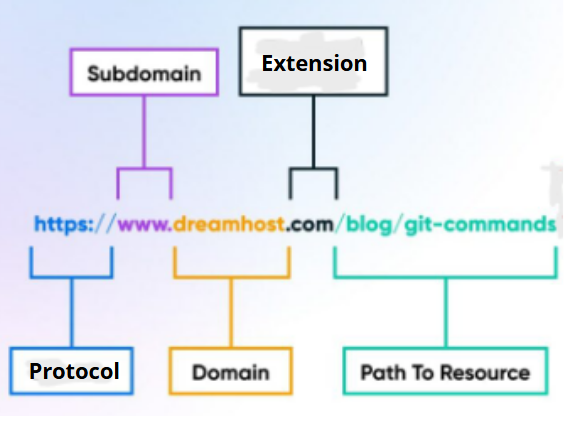
There are 2 types of URL
Absolute : An absolute URL gives complete location information. It begins with a protocol like "http://" and continues, including every detail. An absolute URL typically comes with the following syntax.For web browsing, absolute URLs are typed in the address bar of a web browser. For example, https://www.google.com this gives the complete information about the file location path.
Relative :
Relative means "in relation to", and a relative URL tells a URL location on terms of the current location. Relative path is
used for reference to a given link of a file that exist within the same domain like : image.jpg. However, it would internally be interpreted like the following ./image.jpg
The dot(.) before the "/" in the src attribute is a "special character". It means the location should be started from the current directory to find the file location.
Security in URLs
The "s" in https and the padlock icon allow the identification of a secured webpage. The exchanges of datas will be crypted returning unreadable datas. The most secured case is whenever both padlock and https appears.
